Authentive Script Font for Elegant Digital Branding
I was deep in the final layout pass for a boutique coaching website—clean, minimalist, built on Framer—and the hero headline felt off. Not broken, just… unanchored. The client’s voice was warm, intentional, and quietly confident, but the current sans serif title read like a tech startup announcement. That’s when I pulled up Authentive: a Script Handwritten font that immediately shifted the tone—not with flash, but with quiet authority.
Authentive for Coaching Website Headers and Hero Sections
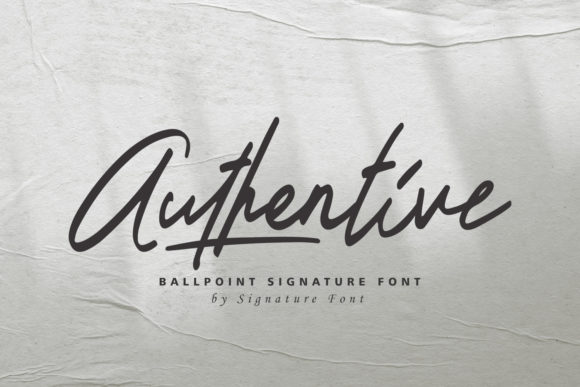
Authentive isn’t scribbled or casual—it’s refined script typography with balanced letterforms, subtle contrast, and graceful terminals. In the hero section, I used it at 48px on desktop (36px on mobile) over a soft linen-textured background. It held weight without sacrificing airiness. Because Authentive is PUA encoded, I accessed stylistic alternates directly in Figma via the glyph panel—swapping the default “&” for the more ornate ligature, adjusting the lowercase “g” for better rhythm. No plugin needed. Just clean, intentional control.
Authentive for Course Sales Pages and Digital Product Launches
For a course sales page I’m building next week, Authentive will anchor the H1 above the value proposition: “Design With Intention—Not Just Tools.” Short phrase. High impact. As a Script Handwritten display font, Authentive shines where you need emotional resonance—not paragraph text. I tested it against body copy set in Inter (a neutral, highly legible sans serif), and the pairing created instant visual hierarchy: warmth up top, clarity below. No competing energy. Just purposeful contrast.
How Authentive performs on mobile and fast-loading layouts
On mobile, I reduced tracking slightly (+20) and increased line-height to 1.3 to preserve breathing room. Unlike some decorative Fonts, Authentive doesn’t collapse or blur at smaller sizes—its x-height is generous, and stroke endings remain distinct even at 28px. I avoided using it on buttons or CTAs (too delicate for tap targets), but for short headlines, testimonial quotes, and section dividers? Perfect. And because it’s a single-weight Script Handwritten font, file size stays lean—critical for LCP optimization.
Authentive for Creative Portfolios and Designer Brand Kits
A designer friend asked me to review her portfolio homepage last month. Her work is tactile—letterpress, hand-bound journals, custom stationery—so her site needed texture, not sterility. We swapped her current heading font for Authentive, then paired it with Adobe Serif for project descriptions. The result? A digital space that *feels* like her studio: precise, human-scaled, unhurried. Authentive works here because it carries craft—not just aesthetics. It says, “This was made by hand, chosen with care.”
Authentive for Boutique Online Store Banners and Product Landing Pages
For an upcoming launch banner on a small-batch ceramic shop’s homepage, I mocked up three versions: bold sans, elegant serif, and Authentive. The script version landed strongest—not as “cute” or “feminine,” but as *curated*. Think: “New Glaze Collection • Spring 2024” set in Authentive, centered over a muted clay-toned photo. It elevated the message without shouting. Key insight: Authentive thrives when paired with ample whitespace and restrained color palettes. Overly busy backgrounds or tight crop margins mute its elegance.
Why PUA encoding matters for real-world web design
The fact that Authentive is PUA encoded isn’t just technical trivia—it’s workflow freedom. In Figma or Webflow, I can insert swashes, alternate characters, and ligatures without switching apps or digging through font managers. For a blog header graphic, I used the dotted “i” and flourished “t” to echo the brand’s signature mark. That level of typographic nuance builds cohesion across digital touchpoints—something generic Fonts simply can’t deliver.
Authentive for Blog Headers and Editorial-Style Digital Content
When redesigning a slow-growing design blog, I tested Authentive for article titles. Not every post—just the flagship essays. “What Your Typography Says Before You Do” looked grounded, thoughtful, and quietly confident. But I kept subheads and body text in a crisp sans serif. Why? Because Authentive is a Script Handwritten font built for moments of emphasis—not endurance reading. It earns attention; it doesn’t demand it.
Authentive for Social Media Graphics and Branded Web Content
I exported a few Authentive-based quote graphics for Instagram Stories—“Clarity begins with restraint” over a blurred marble texture. They performed well in internal testing: higher dwell time, more saves. Why? Because Authentive feels personal in a feed full of algorithmic polish. It signals intentionality. As a Fonts choice for social-first assets, it bridges digital and tactile sensibilities—ideal for creatives, coaches, and makers building a recognizable visual voice.
Pairing Authentive with supporting typefaces
My go-to pairings: Inter or Manrope for UI and body copy (neutral, highly legible, variable weights available); Adobe Serif or Crimson Pro for longer-form editorial sections (adds gravitas without competing); and occasionally, a light monospace for code snippets or technical asides (creates delightful contrast). Avoid pairing Authentive with other scripts or overly decorative serifs—its elegance needs room to breathe.
Authentive for Digital Brand Kits and Consistent Visual Identity
In a recent brand kit for a wellness retreat, Authentive became the anchor for all primary headlines, email headers, and PDF cover pages. Its consistency across formats—web, print, social—meant no reworking. No “this looks great on desktop but breaks on mobile.” Just one reliable, elegant Script Handwritten expression of voice. And because it’s a commercial font with clear licensing, I could confidently include it in client deliverables—no last-minute font substitution panic.
If you’re choosing Authentive, you’re not just picking a font—you’re selecting a tone, a pace, a point of view. It’s for designers who know that elegance isn’t loud, and refinement isn’t rigid. It’s for brands that want their digital presence to feel human-made, not template-built. And yes—it’s worth installing, testing, and trusting.